What is Pharmaceutical Chemistry? Exploring Research, Careers, and Graduate Study
How training in pharmaceutical chemistry can lead to a dynamic research career and breakthroughs in patient care.
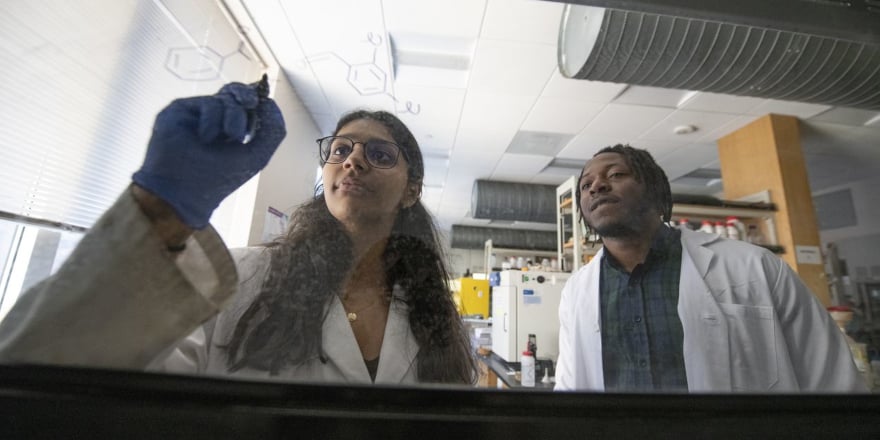
Interested in pharmaceutical chemistry, but aren't sure what types of educational and career opportunities are available to you? Learn about the field and schooling through the Massachusetts College of Pharmacy and Health Sciences (MCPHS).
At its core, pharmaceutical chemistry examines how chemical structure influences biological activity, then harnesses that knowledge to craft, refine, and evaluate therapeutic compounds. By uniting expertise from organic synthesis, molecular biology, and cutting-edge analytical techniques, pharmaceutical chemists ensure that promising drug candidates emerge as stable, high-quality medications capable of improving and often saving lives worldwide.
If you're fascinated by the intricate world of molecules and eager to make a tangible impact on patient care, pharmaceutical chemistry offers a clear path to channel that curiosity. In this guide, you'll learn how it differs from yet complements medicinal chemistry, discover the skills you'll develop, explore career possibilities, and see how graduate study can accelerate your journey into this vital field.
What is pharmaceutical chemistry?
Pharmaceutical chemistry is the scientific engine behind today's therapeutic breakthroughs. In practical terms, it is the discipline dedicated to discovering, designing, developing, and evaluating drug candidates, then guiding each compound through formulation, quality testing, and regulatory scrutiny until it becomes a medication you can trust.
As a student, you would draw on a wide array of scientific specialties:
- Organic chemistry: Powers the synthesis of new molecules and the modification of existing ones.
- Biochemistry and molecular biology: Clarifies how those molecules interact with enzymes, receptors, and genetic pathways inside the body.
- Pharmacology: Determines how a potential drug behaves in living systems, shaping dosing and safety profiles.
- Analytical and physical chemistry: Provides the tools to confirm purity, stability, and bioavailability, ensuring every batch meets exacting standards.
- Inorganic chemistry: Contributes essential insights into metallic or mineral-based agents and delivery systems.
Together, these perspectives create a holistic approach that stretches from the first sketch of a molecular structure to large-scale manufacturing. You would design viable synthetic routes, troubleshoot formulation challenges, and establish analytical methods that prove a drug's identity and quality across its entire shelf life.
That full-spectrum expertise turns laboratory discoveries into therapies that improve patient care and global health, whether it's a small-molecule antiviral or a targeted oncology agent. If you're ready to build that level of impact into your career, exploring a graduate program such as the Master of Science in Medicinal Chemistry can equip you with the foundational knowledge and laboratory skills valued across pharmaceutical chemistry roles.
Is pharmaceutical chemistry the same as medicinal chemistry?
The short answer: not quite. While the two fields overlap and often collaborate closely, each occupies a distinct niche within the drug-development pipeline.
Medicinal chemistry focus
Medicinal chemists are the architects of new drug molecules.
This discovery-driven mindset makes medicinal chemistry the launchpad for potential treatments, especially in areas such as oncology, infectious disease, and neuroscience, where unmet medical needs remain high.
Pharmaceutical chemistry focus
Once a promising molecule emerges, pharmaceutical chemists broaden the lens.
Because of this wider scope, these professionals routinely collaborate with pharmacologists, toxicologists, clinicians, and regulatory experts to usher a therapy through clinical trials and onto the market.
Bridging the two through education and careers
If you're weighing which specialty to pursue, remember that foundational knowledge in one area can accelerate success in the other. A rigorous graduate program, such as our Master of Science in Medicinal Chemistry at MCPHS, equips you with deep synthetic expertise that translates seamlessly to formulation, analytical development, and quality control roles across the pharmaceutical industry and contract research organizations.
In short, the skills you gain won't lock you into one silo; they open doors across the entire spectrum of drug discovery and development.
Because drug discovery and development rarely progress in a straight line, you would routinely collaborate with pharmacologists, toxicologists, and clinical researchers.
What careers are available in pharmaceutical chemistry?
With expertise that spans synthesis, analysis, and formulation, pharmaceutical chemists find professional homes in a wide range of settings. Here is a snapshot of where your degree can take you and what you might do day to day:
- Pharmaceutical chemist: Plan synthetic routes, scale reactions, and troubleshoot manufacturing challenges to keep drug pipelines moving forward.
- Medicinal chemist: Brainstorm novel structures, run SAR studies, and collaborate with biologists to validate targets.
- Analytical chemist: Develop and validate assays that confirm identity, potency, impurity profiles, and dissolution rates.
- Formulation scientist: Experiment with excipients, coatings, and delivery devices to turn active ingredients into patient-friendly dosage forms.
- Quality control scientist: Sample production batches, analyze results, and document compliance to meet regulatory expectations.
- Drug development scientist: Coordinate cross-functional teams, manage timelines, and prepare submissions for clinical trials.
- Research associate: Perform experiments that uncover new mechanisms of action or refine existing therapies.
- Laboratory manager: Oversee safety, equipment calibration, and personnel training in university or government labs.
Work environments include pharmaceutical companies, biotechnology firms, contract research organizations (CROs), government labs, and academic institutions. Whether you're driven by discovery, hands-on lab work, or regulatory science, you can tailor your career to match your interests.
How an MS in medicinal chemistry prepares students for pharmaceutical chemistry careers
At MCPHS, we designed our Master of Science in Medicinal Chemistry program to give you a competitive edge through:
- Rigorous scientific foundation: Core courses dive deep into organic synthesis, drug-receptor interactions, pharmacokinetics, and contemporary analytical methods, ensuring you understand every stage of drug development.
- Research-intensive training: From day one, you'll contribute to faculty-led projects tackling real therapeutic challenges, building a publication-ready portfolio, and sharpening your problem-solving skills.
- Faculty expertise: You'll learn directly from researchers who have advanced antiviral agents, oncology therapeutics, and novel delivery technologies, insights you can't glean from textbooks alone.
- Laboratory proficiency: Small lab sections emphasize hands-on mastery of NMR, HPLC, mass spectrometry, and computational modeling, so you graduate ready to lead experiments rather than just observe them.
- Career readiness: Whether your goal is an industry bench role, a biotech startup, or a PhD in chemical biology, our curriculum, professional-development workshops, and extensive New England industry network position you for success.
If you're eager to transform scientific curiosity into life-changing medicines, there's no better time to act. Apply to the MS in Medicinal Chemistry at MCPHS today to start building the knowledge, laboratory expertise, and professional network you need for a flourishing career in pharmaceutical chemistry.
Explore medicinal chemistry at MCPHS